
The Short Answer
If your garage door isn't reinforced, it's the first thing a strong wind event will take out — and once it fails, wind pressure gets inside your house and starts working on your roof and walls from underneath. The fix is a combination of checking your door's wind rating, tightening up tracks and hardware, and not ignoring small symptoms like rattling panels or a door that shudders when gusts hit it. Fall is the right time to do this, before the next cold front blows through the West Valley.
Why the Garage Door Is Your Home's Weakest Wall
Every other exterior wall on your house is a solid, continuous structure. Your garage door is a large moving panel held in place by tracks, rollers, hinges, and a handful of bolts — and it's often the single biggest opening in the entire house. When wind hits a closed house, pressure builds up on the windward side and tries to find a way in. A standard residential garage door isn't built to resist that kind of sustained push, especially an older door or one that's never been upgraded.
Once a garage door buckles or blows in, the wind pressure inside the structure increases dramatically. That's when you start seeing roof damage, blown-out windows, and even wall separation. This isn't a garage-only problem — it's a whole-house problem that starts at the weakest point.
What This Season Brings to the West Valley
Late monsoon storms can still roll through into early fall, bringing sudden wind bursts and blowing dust ahead of any rain. On top of that, as temperatures start dropping and fronts move through Buckeye, Goodyear, and the rest of the West Valley, gusty wind events become more common through the fall and winter months. A door that held up fine on a calm 110-degree July afternoon can behave very differently when it's hit broadside by a 40-plus mph gust.
There's also a hardware angle specific to this climate. Months of extreme dry heat cook factory lubricant out of rollers, hinges, and springs, leaving components stiffer and more prone to binding or cracking under stress. Add in UV exposure that can make plastic rollers brittle and weather stripping brittle or shrunken, and you've got a door that's structurally weaker going into wind season than it was in spring.
Warning Signs Your Door Won't Hold Up
- Visible flex or bowing in the door panels when it's windy, even with the door closed.
- Rattling or banging along the tracks during gusts — this usually means loose track bolts or worn rollers.
- Gaps at the sides or bottom where you can see daylight or feel air movement; this means wind can get a grip on the door's edge.
- A door that's hard to open or close smoothly, which often points to dried-out lubrication or a track that's slightly out of alignment.
- Visible rust or corrosion on hardware, which weakens bolts and brackets right where you need them strongest.
- An opener with no battery backup, which matters if a storm knocks out power while the door is open.
None of these are reasons to panic, but each one is a point of failure that gets worse under wind load.
Steps to Reinforce Your Door Before the Next Wind Event
1. Check for horizontal bracing
Many standard doors, especially older ones, don't have horizontal struts across the back of the panels. Adding steel reinforcement struts significantly increases the door's ability to resist wind pressure without buckling. This is one of the most effective upgrades for a door that otherwise looks fine but isn't built for high wind.
2. Tighten and inspect the track system
Loose track brackets let the door shift side to side under pressure, which is exactly what you don't want in a gust. Walk the full length of both tracks and check that every bracket is snug against the frame.
3. Replace worn rollers and hinges
Cracked or glazed rollers (common after a summer of dry heat) don't move smoothly and put uneven stress on the track. Nylon rollers with sealed bearings tend to hold up better here than plain steel ones.
4. Reset or replace weatherstripping
UV exposure shrinks and cracks the rubber seals along the sides, top, and bottom of the door. Beyond keeping dust and rain out, a tight seal also reduces the surface area where wind can catch an edge and start prying.
5. Confirm the auto-reverse and opener function properly
If a storm knocks out power while the door is mid-cycle, you want an opener that fails safely. A battery backup also means you're not stuck with an inoperable door right when you need to secure the house.
6. Re-lubricate everything
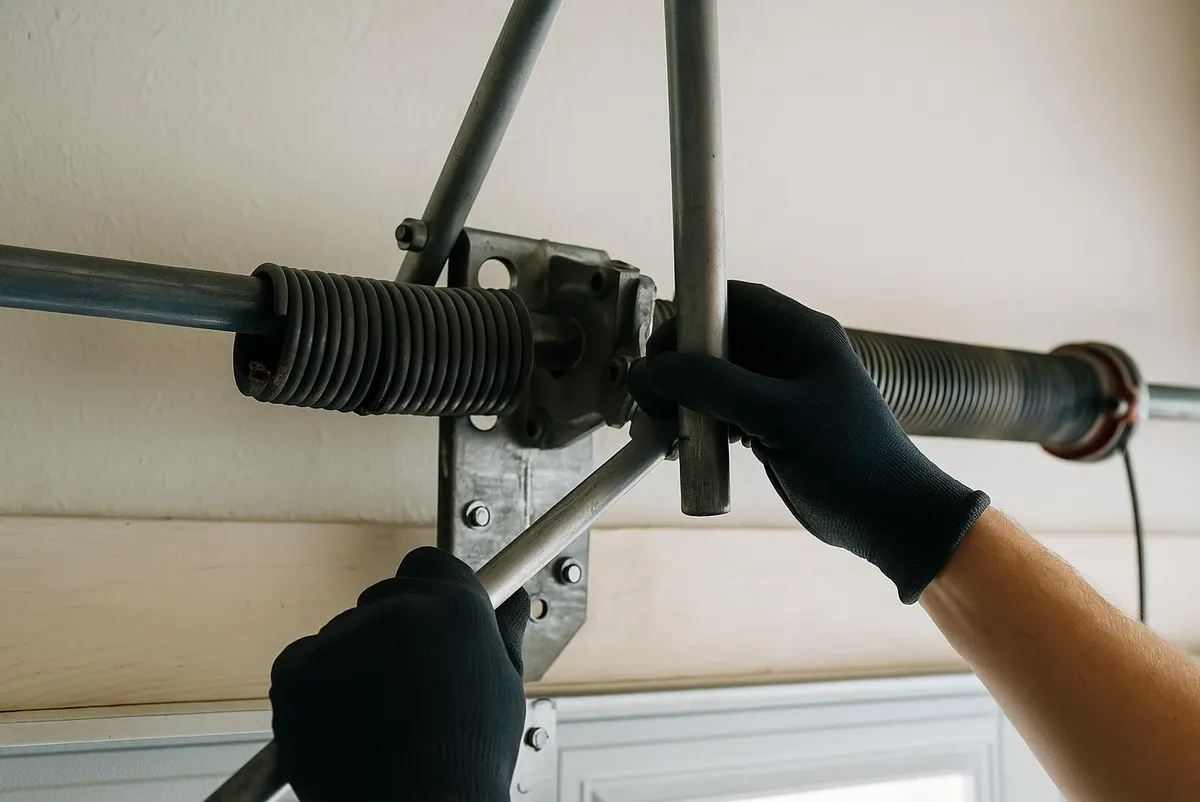
Dry heat strips factory lubricant faster than most homeowners expect. A fresh application of garage-door-specific lubricant on rollers, hinges, and the torsion spring keeps everything moving as it should instead of binding or grinding under load.
When to Call Buckeye Garage Door
If you've noticed flexing panels, a door that rattles in the wind, or hardware that looks rusted or loose, that's worth a professional look before the next storm rolls through — not after. Our garage door maintenance & tune-up service covers the roller, track, and lubrication work that most doors are overdue for after a summer of dry heat, and our garage door spring replacement service handles the springs that have quietly weakened from months of thermal stress. We'll also flag any door that needs added bracing or hardware upgrades to actually hold up under wind load, rather than just looking fine until it doesn't.
If you're in Buckeye, Goodyear, Avondale, Litchfield Park, Surprise, Tolleson, Verrado, or Sun City West and want your garage door checked out before the next wind event hits, call Buckeye Garage Door and we'll get it handled.